DE
Insights Media Careers
Contact
A blue BMW i3 50 xDrive with glowing headlights viewed from a low front three-quarter angle. Above it, the Northern Lights colour the night sky. On the left, a map of Europe shows the route from the North Cape to Tarifa.
Innovation 23.11.2026 5 MIN

Record-breaking road trip from the North Cape to Tarifa: The new BMW i3 50 xDrive covers 5,886.7 kilometres with just under 166 minutes of charging.

Eight countries, 5,886.7 kilometres in three days, two hours and 41 minutes of driving: in the Paneuropeana electric car rally, charging time is what counts. The BMW i3 50 xDrive spent just two hours, 45 minutes and 54 seconds at the charger, setting a new record. Average energy consumption was just 12.5 kWh per 100 kilometres.

With its sixth-generation eDrive technology, DC charging power of up to 400 kW and a drag coefficient of just 0.21, the first all-electric BMW 3 Series Sedan takes efficiency and long-distance capabilities to record levels.

Side view of a blue BMW i3 50 xDrive beneath green Northern Lights. Its headlights and rear lights are illuminated against a dark landscape.

Across Europe, from top to bottom.

At the North Cape, Europe extends into the Arctic Ocean. Here, on the Norwegian island of Magerøya, the rally begins. At 71° 10′ 21″ N / 25° 47′ 40″ E and some 2,100 kilometres from the North Pole, it’s the northernmost point of the continent that can be reached by car. The destination is Tarifa, at the eastern end of Spain’s Costa de la Luz. Located in the Andalusian province of Cádiz at the southern tip of mainland Europe (36° 0′ 23″ N / 5° 36′ 31″ W), Tarifa is almost 6,000 kilometres from the start of the rally, which passed through Norway, Finland, Sweden, Denmark, Germany, Luxembourg, France and Spain. There was just one question to be asked: who would spend the least time charging?

The record-breaking BMW i3 50 xDrive and the accompanying BMW i3 50 xDrive drive one behind the other along a multilane road. Both cars are blue and pictured from the rear. Trees and other vehicles appear blurred in the background.
Five members of the BMW EfficientDynamics team stand on either side of the blue BMW i3 50 xDrive, pictured at the finish in Tarifa. The car is viewed from the front. In the background the ocean, coastline, buildings and a historic tower can be seen.

The BMW EfficientDynamics team rose to the challenge with the BMW i3 50 xDrive – and succeeded in setting a new record. The Paneuropeana electric car rally is considered a benchmark for range and charging speed, and a test of efficiency and long-distance capabilities. The winner is whoever crosses Europe via the specified checkpoints with the shortest total charging time. 

The figures.

Average energy consumption is the key figure for this adventure.

  • Distance: 5,886.7 kilometres across eight countries
  • Driving time: 3 days, 2 hours, 41 minutes
  • Average speed: 79.7 km/h
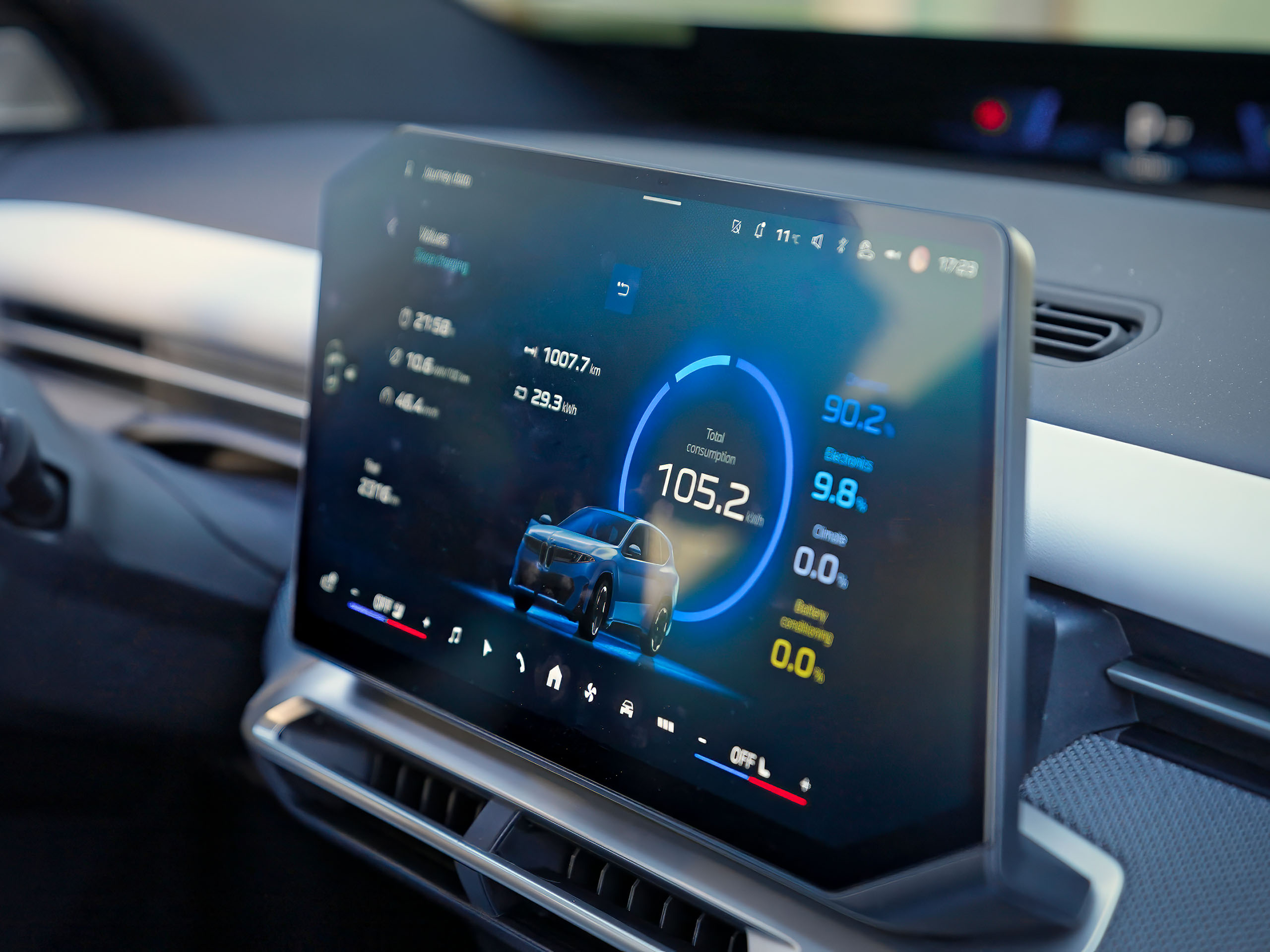
  • Average consumption: 12.5 kWh per 100 kilometres
  • Record-low charging time: 2 hours, 45 minutes, 54 seconds (DC high-power charging)
  • Average charging power: 275 kW

The WLTP is a standardised test cycle that allows vehicles to be compared. In the BMW i3 50 xDrive, it puts energy consumption at between 18 and 13.4 kWh per 100 kilometres1. But on this record-breaking journey, consumption was even below the lower end of this range. On other routes, consumption may vary, depending on driving style, speed and weather conditions.

Mike Reichelt, Head of Neue Klasse, BMW Compact and Midsize Class:

“The almost 6,000-kilometre Paneuropeana across Europe is impressive proof of the full everyday usability of our new BMW i3 based on the Neue Klasse. With a total charging time of just two hours and 46 minutes, we beat the previous record from 2017 by more than seven hours. To me, this is a strong demonstration of the capabilities of our new technologies and a tremendous team achievement that we can all be proud of.”

A series-produced vehicle, public charging points, free choice of route.

The stages and checkpoints of the route were chosen to ensure that participating vehicles drive in regular, everyday traffic, along country roads and motorways as well as through cities. In this rally, charging time is what counts.

The record-breaking BMW i3 50 xDrive and the accompanying BMW i3 50 xDrive drive one behind the other along a multilane road. Both cars are blue and pictured diagonally from the front, with mountainous scenery in the background.

Charging points on the route are not prescribed, so the team planned the route themselves between checkpoints, taking weather, traffic conditions and other factors into account. The BMW i3 was charged exclusively at public charging stations available to everyone. The challenge is to choose charging stations that allow a highly efficient fast-charging vehicle to realise its full potential.

The record-setting vehicle was only ever occupied by a single engineer. The remaining team members travelled in the accompanying cars: an identical BMW i3 50 xDrive and a BMW iX3 50 xDrive. All three vehicles had exactly the same hardware and software as the production models available to customers.

Charging: A BMW i3 50 xDrive at an IONITY fast-charging point. Four members of the BMW EfficientDynamics team stand to the rear of the car. In the background, an additional charging point, a road and autumnal trees can be seen.

FAQs on the record-breaking BMW i3 50 xDrive road trip.

The BMW i3 50 xDrive spent a total of two hours, 45 minutes and 54 seconds charging in the Paneuropeana. That was the time required to charge for the 5,886.7 kilometres between the North Cape and Tarifa. Average charging power was 275 kW. The BMW i3 50 xDrive set a new record.

The BMW i3 50 xDrive used on average 12.5 kWh per 100 kilometres, falling below official combined figures in the WLTP of between 18 and 13.4 kWh per 100 kilometres1. The WLTP is a standardised test cycle that allows vehicles to be compared. In everyday driving, figures may vary depending on driving style, speed and weather conditions.

The BMW i3 50 xDrive drove 5,886.7 kilometres from the North Cape in Norway (71° 10′ 21″ N / 25° 47′ 40″ E) to Tarifa in Spain (36° 0′ 23″ N / 5° 36′ 31″ W). The route passed through Norway, Finland, Sweden, Denmark, Germany, Luxembourg, France and Spain. Actual driving time was three days, two hours and 41 minutes.

The new BMW i3 50 xDrive charges at up to 400 kW (DC) and has a range of up to 912 kilometres in the WLTP cycle1. At a suitable DC charging point, ten minutes is enough to add as much as 423 kilometres of range (WLTP)1. The high-voltage battery has a usable energy capacity of 108.7 kWh.

The new BMW i3 50 xDrive has a drag coefficient of 0.21, making it the most aerodynamically efficient BMW of all time. The drag coefficient is a measure of air resistance. The lower the figure, the less energy the car needs at high speeds.

1 BMW i3 50 xDrive Sedan: Combined energy consumption of 18—13.4 kWh/100 km (WLTP); CO2 emissions combined: 0 g/km (WLTP); CO2 class(es): A; electric range: 729–912 km (WLTP). Actual range and charging power depend on various factors including load, driving style, route, weather conditions, auxiliary electrical equipment (e.g. air conditioning), tyres and battery ageing.