






A team member that never tires, lifts heavy components and is built entirely from high-tech: humanoid robots in production mark a major technological leap. Now, BMW Group Plant Leipzig is running a pilot project that brings physical AI to Europe. The new competence centre is driving the integration of artificial intelligence (AI) and robotics worldwide. First deployed at the BMW Group’s US plant in Spartanburg, humanoid robots have already proven a success – and offer a fascinating glimpse into the production of the future.

Production
21.09.2026
7 MIN
Leipzig debut: BMW Group introduces humanoid robots – a first in Germany.
Human meets machine: AEON sets to work at BMW Group Plant Leipzig.
At BMW Group Plant Leipzig, the day is unfolding as usual – until suddenly, a new colleague appears. It’s human-like in form and made of metal and electronics, and instead of feet, its legs glide on wheels. Its name? AEON.
AEON is a humanoid robot with a clear mission: to support people, not replace them. As well as taking on repetitive tasks, AEON delivers materials to the line, navigating around obstacles along the way. Standing 1.65 metres tall and weighing 60 kilograms, it moves through the hall at speeds of up to 2.5 metres per second.
Sounds like science fiction, right? At the BMW Group, this is gradually becoming reality!
With the launch of the pilot project at Plant Leipzig, the BMW Group is introducing humanoid robots to production in Germany for the first time. Although this may look like a vision for the future, it is actually driven by a clear strategy: rather than staying in server rooms, AI is stepping out to create impact where it matters most – at the very heart of manufacturing.
AI goes physical: Data in motion.
At the BMW Group, digital AI meets real machines and robots – creating physical AI. While AI agents make decisions, learn from data and steer the robots, the humanoids themselves translate their intelligence into physical movements.

Digitalisation makes our production more competitive, both here in Europe and worldwide. This symbiosis of engineering expertise and artificial intelligence opens up entirely new opportunities in production.
This integration of technologies starts not with the robot itself, but with the architecture behind it. In recent years the BMW Group has systematically converted its production system to a uniform IT and data model. Data silos that once operated separately now flow into a shared platform, where information is consistent, standardised and accessible at any time.
From lab to line: How physical AI came to production.
With that, the foundation is now in place for AI agents to handle demanding tasks autonomously and in complex surroundings – from the virtual factory with its digital twins, via AI-assisted quality inspections, all the way to intralogistics using autonomous transport solutions. When all of this is combined with robots, the result is physical AI: intelligent, adaptive systems directly on the shop floor.
“Our aim is to be a technology leader and integrate new technologies into production early. Pilot projects help us test and evolve the use of adaptive AI-enabled robots – also known as ‘physical AI’ – in a real-world industrial setting,” says Michael Nikolaides, Senior Vice President Production Network, Supply Chain at the BMW Group.
Digitalisation and AI, then, are more than just a nice-to-have; they are central to the BMW iFACTORY and a prerequisite for keeping production flexible, efficient and future-ready.
Muscle power from metal, brainpower from humans.
Robots have been part of everyday operations at the BMW Group for decades. Traditional industrial robots perform welding, bonding and lifting with exceptional precision – but are fixed in place and limited to a clearly defined set of tasks. Humanoid robotics, on the other hand, takes things one step further, bringing additional capabilities to the system for maximum employee benefit.
For the BMW Group, humanoid robots enhance existing automation by adding a further layer of value: their greatest strength is their ability to perform repetitive tasks or jobs that require humans to work in physically demanding positions.
So now, instead of lifting the same heavy component time and again or having to work while bending down, employees are increasingly using their talents where they count: to understand processes, steer workflows, check quality and integrate new technologies into everyday operations.

New AI and robotics centre: Building production for tomorrow.
To make this possible, the BMW Group has pooled its expertise in the Centre of Competence for Physical AI in Production. Here, specialists in AI and robotics come together to evaluate technology partners and develop and oversee pilot projects from the concept and lab stages through to deployment in the plant and to pilot operation in the real-world manufacturing environment.
The international team of experts is advancing its own research in the field of robotics and gradually integrating AI into the existing production system. The result is a growing modular set of physical AI solutions for BMW Group plants worldwide to use – supporting their employees as best they can.

Physical AI in action: Plant Leipzig as a robotics testbed.
Plant Leipzig is currently launching the first European pilot project involving a humanoid robot in the BMW Group production network. The initiative is being carried out in collaboration with Hexagon, a longstanding partner of the BMW Group in sensor technologies and software. Hexagon’s physical AI division, Hexagon Robotics, based in Zurich, Switzerland, introduced its AEON humanoid robot in June 2025.
AEON’s rollout follows a clear plan, beginning with a theoretical assessment and subsequent laboratory testing. AEON made its operational debut at Plant Leipzig in December 2025. Additional testing is scheduled for April of this year to prepare for its full integration into pilot operations in the summer of this year.
The centrepiece of AEON is its human-like torso, which can be equipped with a range of gripping tools, hands or scanning devices, allowing it to perform a variety of tasks without changing its core structure. Once deployed, the robot rolls flexibly through the workspace.


AEON learns series production: Humanoid robot in practical testing.
At Leipzig AEON will initially support high-voltage battery assembly and component production. It will take over wherever repetition, precision and ergonomics are critical. But rather than focusing on a single task, the question is how the human-like machine can be meaningfully integrated into series production.
To find out, AEON is being introduced into the existing system gradually, from battery production for energy modules to component manufacturing for exterior parts. The teams will test how workstations can be adapted and explore which tasks could be suitable and where the robots offer the greatest benefits. So, rather than having the technology imposed on them, employees themselves will be actively involved in determining how it is used.
Test run in Spartanburg: 30,000 BMW X3 vehicles, 1.2 million steps.
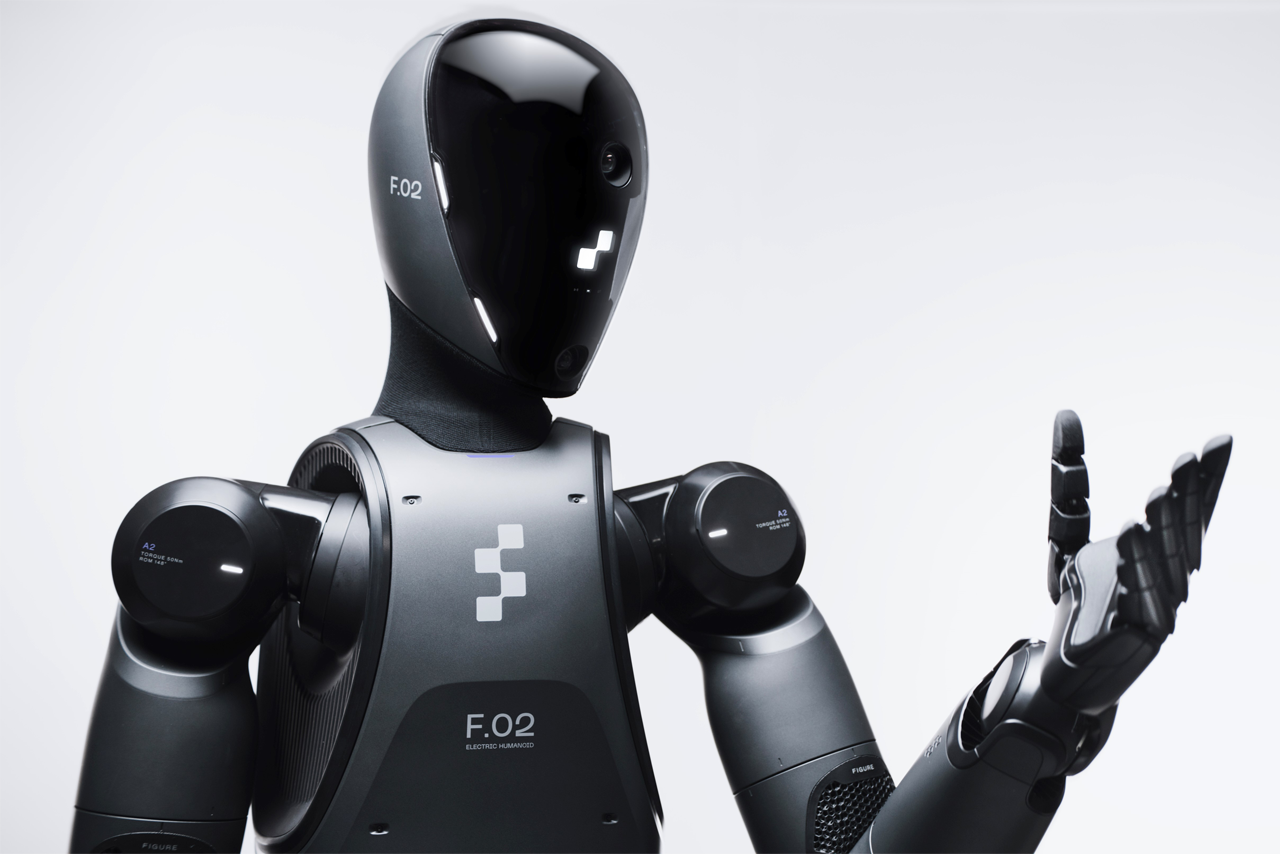
Before AEON showed up for its first day of work in Leipzig, another humanoid robot had already demonstrated the powers of physical AI in vehicle production – at BMW Group Plant Spartanburg, in South Carolina, US. In 2025 Spartanburg launched a pilot project with the technology company Figure AI, marking the first deployment worldwide of humanoid robots in a BMW facility.
Over a ten-month period, the robot, called Figure 02, assisted in the production of more than 30,000 BMW X3s. Operating five days a week for ten hours per shift, Figure 02 retrieved and positioned sheet metal parts for welding. During that time, it moved over 90,000 components and clocked up some 1,250 operating hours, plus around 1.2 million steps.
Figure 02 was found to perform repeatable tasks – such as positioning components with millimetre accuracy – reliably and with absolute precision. The pilot project also delivered important insights into the further development of physical AI in production, including revised safety concepts with additional barriers and partitions, and improved 5G coverage in the hall.

From lab to line: How Figure 02 joined the team.
The transition from lab operations to shift work in production progressed faster than expected. Having learned the required motion sequences in a test environment, Figure 02 was soon able to perform them reliably on the line. Integrated into the BMW smart robotics ecosystem via standardised interfaces, the humanoid robot interacted seamlessly with the existing systems.
The project team in Spartanburg deliberately chose the body shop to test the new robot, as the level of automation there is already high. In addition, the workforce has plenty of experience in using new technologies, and line-side material supply is largely handled by Smart Transport Robots. To ensure transparency, the project’s goals and workflows were communicated early – and when Figure 02 arrived, initial curiosity soon turned into acceptance. Before long, the humanoid robot had become a natural part of day-to-day teamwork on the shop floor.
The successful pilot project lays the groundwork for Spartanburg’s next project, which will see the successor model, Figure 03, handle complex sequencing tasks in logistics. Parts arrive at the plant unsorted and in large containers. The robot will pick and sort them into sequencing trolleys. They will then be collected from a designated collection point by an automated tugger train or Smart Transport Robot and taken directly to the installation station, where they will arrive just-in-sequence.
Sequencing is frequent process in automotive production, and this application offers significant potential for further enhancements and scaling.

More support, more quality, more future: The benefits of physical AI.
Whether in Spartanburg or Leipzig, the BMW Group’s physical AI strategy puts people first. As humanoid robots take on repetitive, physically demanding or safety-critical tasks, employees are free to focus on what truly defines human work: experience, judgment and creativity in handling complex processes.
With the support of this technology, the BMW Group is strengthening its competitive edge to remain at the forefront of developments – without losing sight of the human factor. Employees reap the rewards of better ergonomics and future-proof roles, while customers benefit from flexible, resilient, high-quality production. And for society more generally, this example shows how AI in industry works not against people but with them, shaping the production of tomorrow.