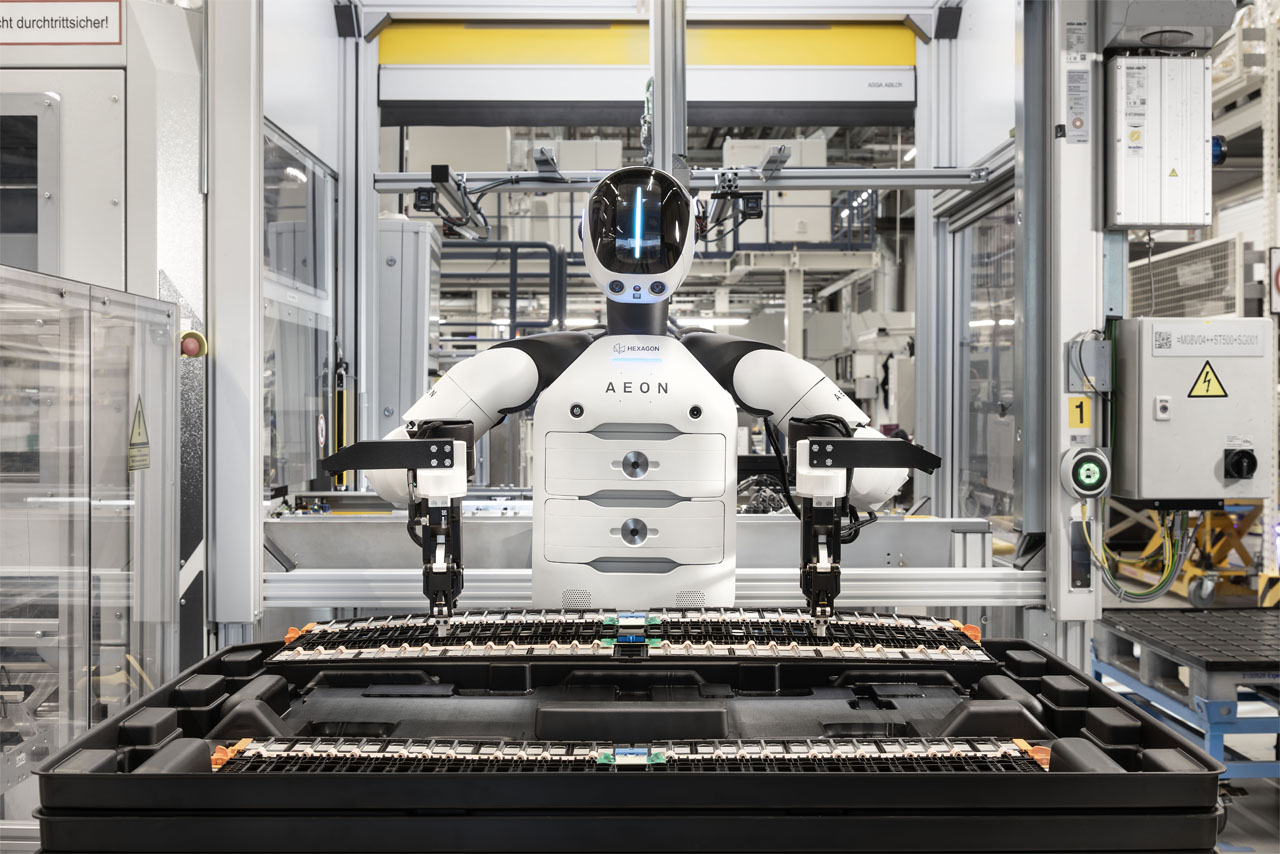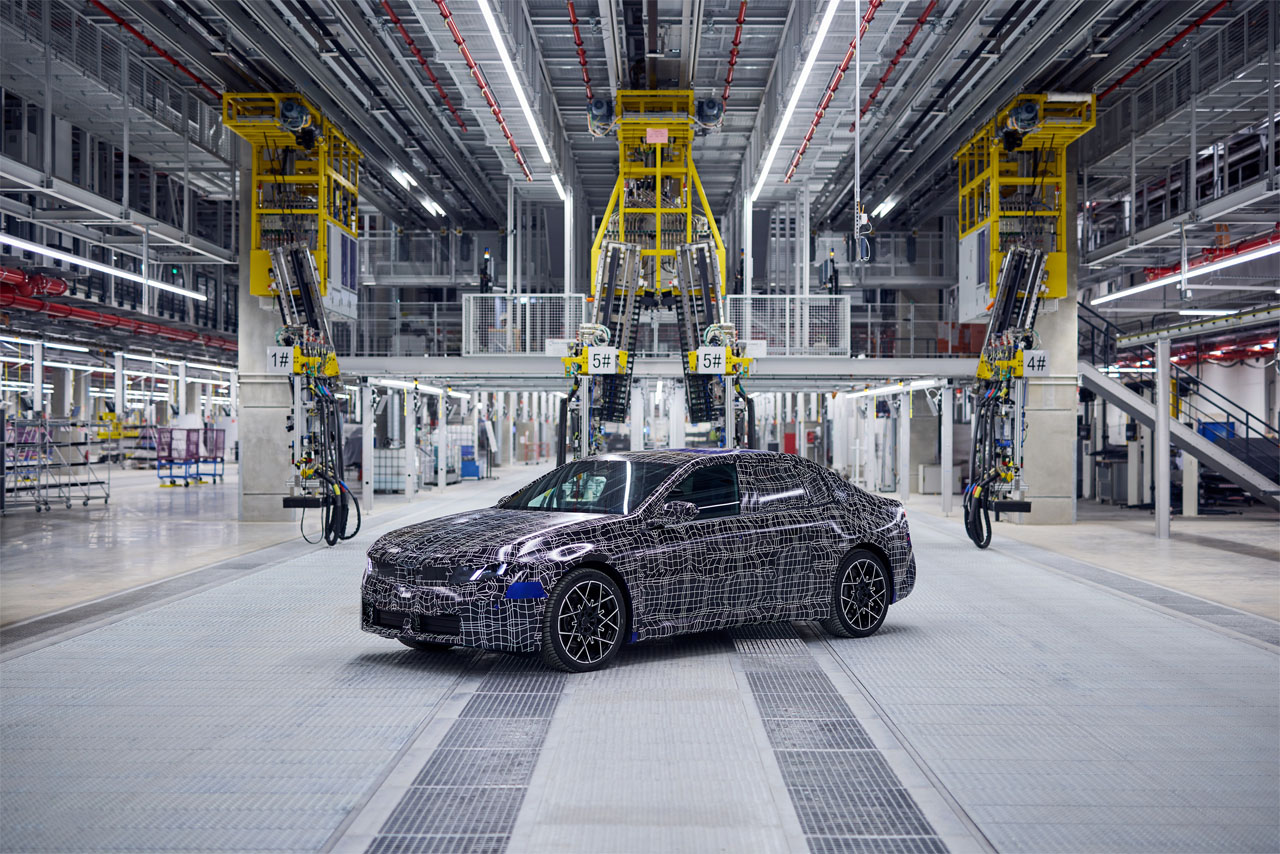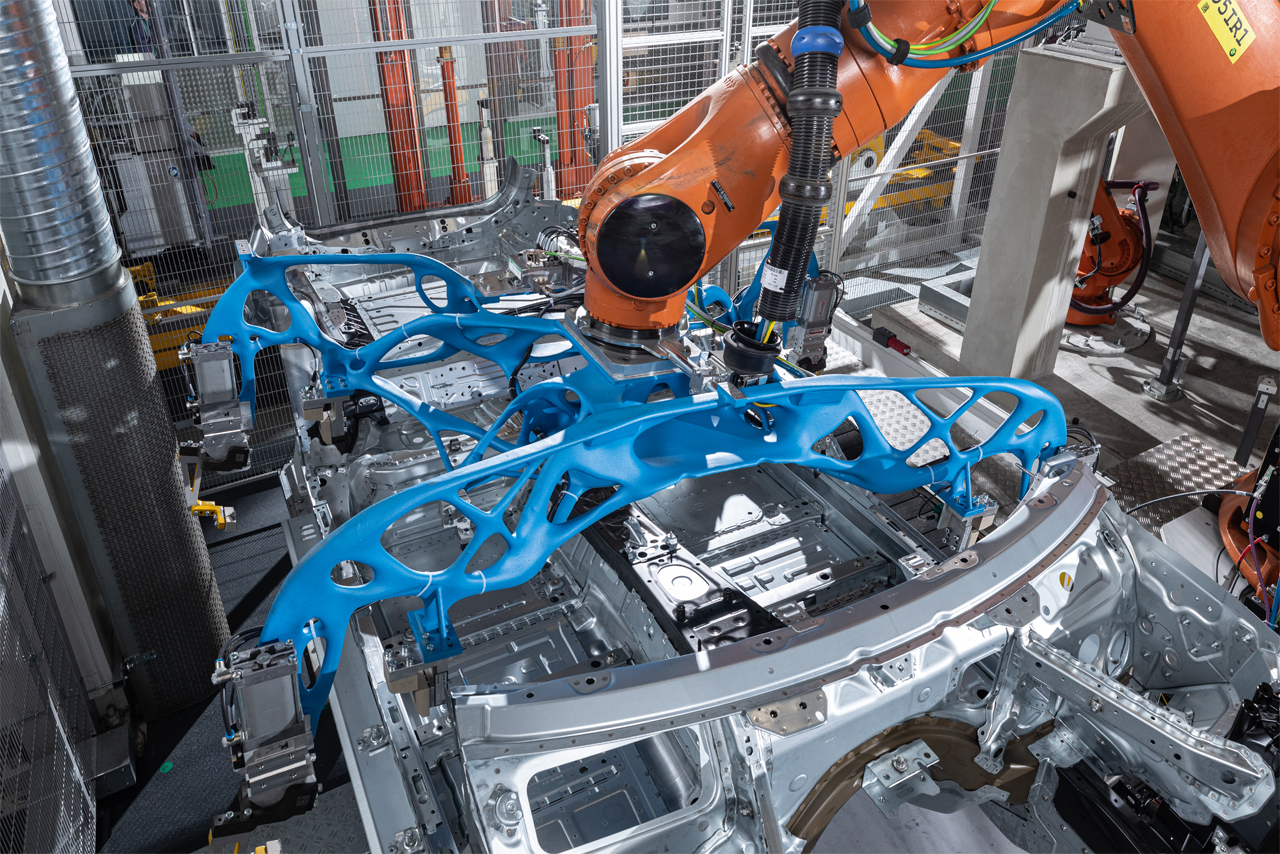








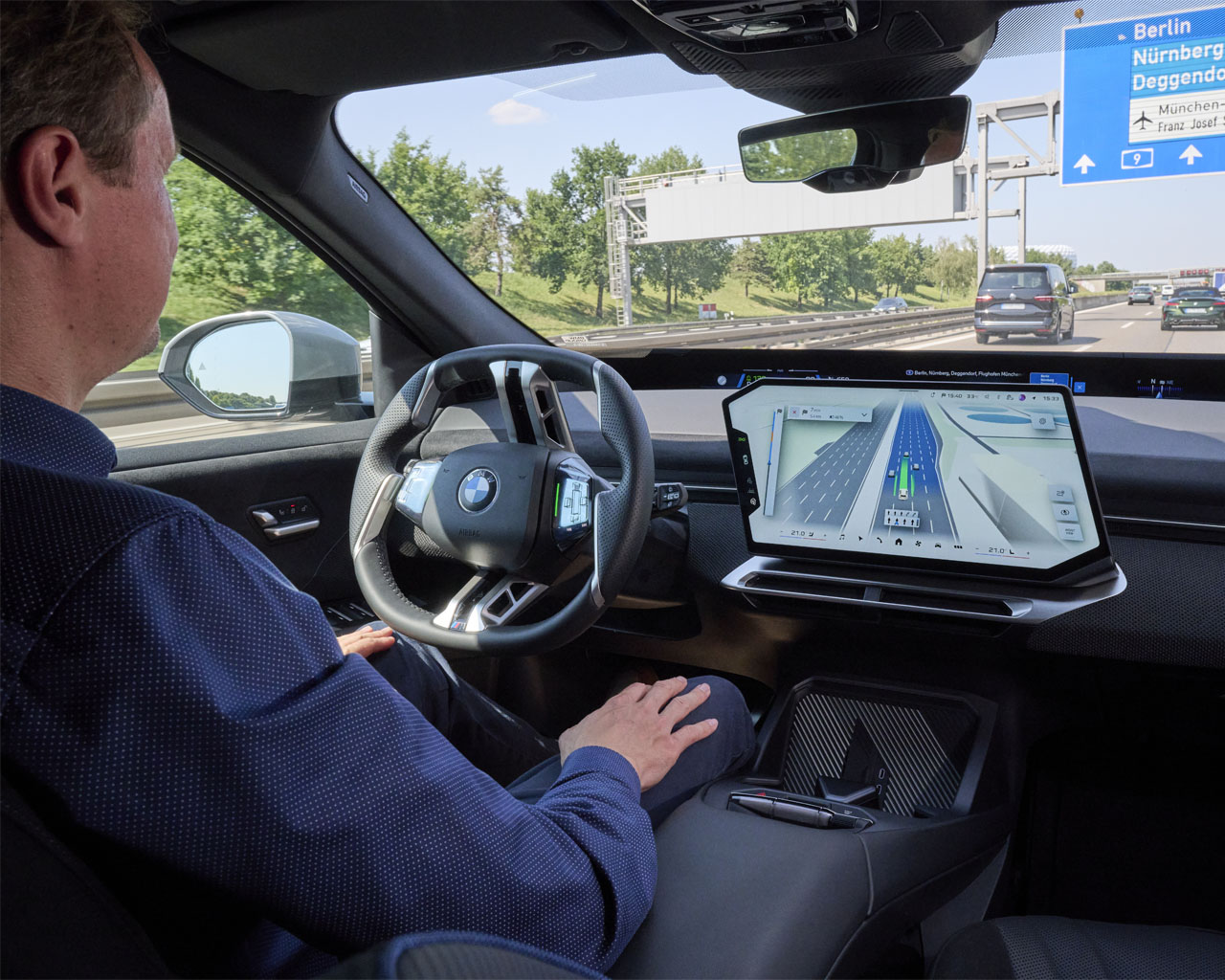

At the Additive Manufacturing Campus (AMC) in Oberschleissheim, just north of Munich, the BMW Group is taking additive manufacturing to the next industrial level: in addition to enhancing automation and broadening technological capabilities, the company is focusing consistently on scalable applications. From 2027 onwards, new systems and Wire Arc Additive Manufacturing (WAAM) in series production will offer further fields of application.

Production
15.07.2026
7 MIN
Additive manufacturing at the BMW Group: How 3D printing is becoming a key industrial technology.
Ever closer to industrial maturity.
Additive manufacturing was long the preserve of prototype and trial component production or special applications. Today, it is an established part of everyday industrial operations at the BMW Group. Better known to many as 3D printing, the technology is gradually evolving into a fully integrated production technology. Rather than being a peripheral solution, additive manufacturing is becoming a relevant building block throughout the vehicle lifecycle.
The next stage of development is now underway, as the team at the AMC systematically expands its expertise, increasing automation and expanding technological breadth with a clear focus on scalable industrial applications – delivering technological progress with tangible impact.
Where speed meets design freedom.
At the BMW Group, additive manufacturing is firmly established at every stage of the product lifecycle, from early concepts and prototype production to applications in series as well as aftersales solutions. It has also long been an integral part of the production system.
The true strength of additive manufacturing lies in its ability to accelerate development processes, increase flexibility in production, and open up new possibilities for component design. Whereas traditional workflows are determined by tool logic and lead times, 3D printing offers unprecedented speed and greater freedom to create custom-fit solutions.

Additive Manufacturing is now fully integrated across all phases of the product lifecycle.
How additive manufacturing accelerates vehicle development.
The real power of additive technologies lies not just in their layer-by-layer construction of components, but in their relevance for development. In addition to delivering parts much faster, additive manufacturing allows targeted modifications to be made as required and parts to be tested in real-world conditions early in the development process.
Today, additive processes already produce highly functional components that are much more than just prototypes: they can be used in dynamic functional tests and even in crash tests. This not only shortens development times but also improves the technical validation of new vehicle concepts.
Additive manufacturing is already supporting the development and validation of
Neue Klasse vehicles. It was also used to produce 3D-printed components for the development of the latest-generation electric drive.

Campus sets the pace for new workflows.
The fact that additive manufacturing is advancing ever faster is closely linked to the AMC. Open since 2020, the AMC brings production, research and training together under a single roof. It is here that new workflows are not only conceived, but also rapidly tested, scaled and rolled out across the company.
The AMC’s role as a pacesetter is also evident in other ways: since launching production, it has manufactured over 1.6 million parts. A further 100,000 components a year are produced decentrally in the vehicle plants.
Additive manufacturing is not just a vision for the future – it is already with us today, in industrial operations across the global production network of the BMW Group.
How new technology delivers faster impact.
With this foundation in place, the next logical step is already underway: the BMW Group is now investing in new systems, larger build volumes and digitally connected process chains. The aim is to integrate additive manufacturing into existing production structures even more closely and effectively – in a way that is technologically robust, economically viable and globally compatible.
Timo Göbel offers a clear description of the guardrails for scaling: “A key pillar of our scaling strategy is the use of automated, digitally networked process chains, and open-material systems as well as open interfaces, all of which allow seamless integration into our existing production structures.”
What sounds quite technical at first actually has a direct practical effect: automated workflows enhance efficiency and process security. Open-material systems increase the technological breadth, while open interfaces provide the prerequisites for the faster integration of new solutions into existing industrial environments. Additive manufacturing at the BMW Group, then, is becoming not only deeper but broader as well.

When larger components are produced closer to the point of use.
As additive manufacturing is scaled, the spectrum of possible components it can produce is expanding. In the future, it will be possible to produce larger components with improved properties in significantly shorter lead times. In addition, many applications will no longer require traditional tools, making them faster and more flexible in equal measure.
New possibilities will open up, especially in production, where high-performance automated systems and larger build volumes will enable the production of large and highly functional components. Further applications will emerge in prototype development, along with opportunities for the broader use of the technology.
This development is also directly benefiting the production system. Fast, robust, user-friendly systems will enable plants worldwide to additively manufacture their own production accessories, decentrally and at short notice. This will increase efficiency and responsiveness across the production network.

WAAM approaches series production.
One particularly promising element in additive manufacturing is WAAM, which is especially suitable for producing large-format metal components. WAAM complements additive manufacturing wherever size, productivity and industrial integratability come together.
The BMW Group is consistently enhancing WAAM technology and gradually rolling it out in series production. It is already firmly established in prototype development, with vehicle testing underway since 2025 and series production of the components scheduled to start in 2027.
The AMC’s discerning standards are particularly evident in its ability not only to identify promising new technologies early, but also to develop them systematically to series maturity.
When technological progress reaches production and the product.
For the BMW Group, additive manufacturing is far more than just specialised technology: it creates tangible benefits for development, production and products. Faster processes shorten the journey from idea to application, while greater flexibility makes it easier to adapt to new requirements. What’s more, increased design freedom helps ensure that components are designed to be functional, efficient and fit for purpose.

And it’s not just in-house workflows that benefit, but also BMW Group customers. Whether for Individual or Edition components, or in series or aftersales applications, additive manufacturing offers not only technical advantages but also commercial benefits, while also laying the groundwork for distinctive product experiences.
Additive manufacturing comes of age – on the road to industrial maturity.
For the BMW Group, additive manufacturing is nothing new. It commissioned the development of its first systems as early as 1990 and 1991, which it then used to produce prototype components. Later, the technology was used in series applications with Rolls-Royce, to manufacture the first series metal components for series production of the BMW i8 Roadster, and to customise components for aftersales.
The difference to today, however, lies not so much in the fact that the technology is being used as in its evolution to industrial maturity. Rather than comprising individual applications, it now forms resilient systems, having developed from a technology with potential to a scalable reality in production. Once a special production solution, 3D printing is gradually evolving to an established production technology.
Or, in the words of Timo Göbel: “We are seeing strong growth in this technology across a wide range of applications at every stage of the product lifecycle, so we will continue to invest.”
The BMW Group takes the next step.
As the AMC continues to develop, the BMW Group is leading the transition of additive manufacturing into a new industrial stage. The focus is on integration, scaling and technology openness – the key prerequisites for transforming innovations into high-performance yet sustainable industrial solutions.
At the BMW Group, additive manufacturing is becoming more and more like other modern production technologies: flexible, connected, highly efficient – and ready for the future.