DE
News Media Careers
News Media Careers
Contact

Data protection notice on the collection of video data from customer fleet operations.

Page Overview

Data protection.

With this notice, we, BMW AG and, where applicable, the respective responsible national sales company (hereinafter: "BMW", "we") would like to inform you about data collection from customer vehicles from April 2026 onwards. This refers to selected, event-triggered video recordings from exterior cameras of certain customer vehicles in combination with other vehicle sensor data, including location. These video recordings are collected to a limited extent in order to develop new technologies for the further development of assisted, connected, partly automated and autonomous driving functions and in so doing, contribute to the continuous improvement of road safety. This initiative supports broader road safety ambitions such as the EU's "Vision Zero", a long-term aim to prevent fatalities and serious injuries in road traffic.

In order to protect any personal data captured by the cameras, BMW has implemented technical measures in the vehicle to obscure faces or licence plates as far as technically possible. Further, data collection takes place only with the drivers' consent.

The background to this initiative is that real traffic situations provide more valuable insights than any test track or simulation. By analysing video data from customer vehicles, we can continuously develop driver assistance systems and thus increase safety for all road users. Effective active safety systems such as the Emergency Brake Assistant not only protect the vehicle's passengers, but also pedestrians, cyclists and other road users.

Data processing is carried out by Bayerische Motoren Werke Aktiengesellschaft, Petuelring 130, 80788 Munich, Germany, domicile and court of registry: Munich HRB 42243 (hereinafter: "BMW AG") and, under certain circumstances, together with the respective responsible national sales company (hereinafter collectively referred to as "BMW").

The respective national sales company provides the customer (e.g. vehicle owner) with certain vehicle-related information and driver assistance systems (hereinafter "services") under the name "BMW ConnectedDrive" (hereinafter "ConnectedDrive contract"). They are the contractual and operational contact for our customer. They are also available to answer any questions you may have regarding the processing of your data. Please find the corresponding address here.

BMW AG is responsible for the technical provision of the services. Data is transmitted from the national sales company to BMW AG to provide the services and to support the customer in the event of problems. 

The development of modern driver assistance systems and active safety functions requires the collection of and training with data from real traffic situations. This enables us to develop functions that work even more reliably and safely in everyday road traffic and in a wide variety of situations.

The data from customer vehicles is intended for the further development and continuous refinement of safety-relevant driver assistance systems and automated driving functions. They also help us to make these systems even more precise and natural.

Example: The Emergency Brake Assistant is a central safety system in modern vehicles. Drivers are issued a visual and acoustic warning in the event of an imminent collision. If necessary, the system automatically initiates emergency braking to prevent accidents or minimise their consequences. This function requires radar sensors and cameras that continuously monitor the vehicle's surroundings.

In general, all driver assistance systems based on object detection can be further optimised by using sensor and video data. They include the Emergency Brake Assistant, Lane Change Assistant, Automatic Park Assistant, Active Cruise Control (ACC), Speed Limit Info and many more.

A variety of different traffic situations, weather conditions and infrastructures can be recorded with customer vehicles. The data from customer vehicles capture those rare traffic situations that are practically impossible to reproduce in test fleets or simulations and are therefore indispensable for the training of reliable safety systems.

By further developing our driver assistance systems, we help to improve road safety even more for all road users. The insights gained from real traffic situations help us to continue designing robust systems and further improve their behaviour in safety-critical situations. In this way, we support the development of modern technologies that contribute to the mobility of tomorrow.

Selected data from real traffic situations is processed for the further development of modern driver assistance systems. It is processed exclusively for a clearly defined purpose: the improvement and further development of safety-relevant assisted, connected, partly automated and autonomous driving functions. The aim is to use these systems to help improve road safety. This data helps to better understand complex traffic situations, make systems more reliable and further improve safety in road traffic in the long term.

The personal data collected through the use of customer vehicles in public road traffic is processed as follows: The vehicles are equipped with various sensors (e.g. radar, ultrasound and GPS sensors) as well as exterior cameras, which record the exterior of the vehicle. However, recordings of the public road area are only stored permanently in clearly defined, safety-relevant exceptional situations in which there is a corresponding technical trigger event. Short, event-related video sequences are only stored permanently for these events for the purposes of technically understanding and analysing the respective traffic situation in the development process. In addition, the recordings are continuously overwritten and thus permanently deleted.

The data collection takes place exclusively in selected BMW brand vehicle types with the BMW Operating System X, which will be introduced in models starting from November 2025.  Only vehicles that are equipped with the necessary sensors and data processing architecture for the situational recording of environmental video data and where the respective customer has given their consent to data recording can participate in the data collection.

The following BMW models are affected: iX3, i3, 7 Series and X5, provided they have the operating system version specified above. Other models are not part of this data collection.

The rollout will start on 1 April 2026, initially in Germany, and will be gradually extended to all member states of the European Economic Area in the weeks that follow.

Video data from the exterior cameras: The outdoor cameras detect fixed objects such as road signs, guard rails, walls or pillars as well as road markings and moving objects such as other vehicles (passenger cars, lorries, motorbikes, bicycles) or other road users such as pedestrians. Their position and direction of movement in relation to the vehicle are recognised in the process. The exterior cameras can also be used to capture licence plates and lettering on vehicles, road signs, buildings in the vicinity and other information in the vehicle's immediate vicinity.

Why do other road users also have to be recorded?

When recording data, other vehicles and road users such as pedestrians or cyclists in the vicinity can also be recorded.  Such recordings are necessary because they depict real traffic situations that require technical analysis for the further development of driver assistance systems.

For driver assistance systems to work reliably, they must be able to learn from many real-life situations. This requires selected video data from actual traffic situations. In such situations, people standing in the vehicle's vicinity may also be visible, as they are part of the real traffic situation that is relevant for the technical analysis. BMW is not interested in identifying any persons and our systems are not configured for such purposes. When processing the camera images in our back end, they are only assigned to the general object category "person", as identification is not required for the development of the assisted, connected, partly automated and autonomous driver assistance functions. 

Examples of such real traffic situations are turning vehicles with crossing cyclists, partially concealed pedestrians, unexpected obstacles on the road or the trigger of an emergency braking manoeuvre. The selected video data is collected from such real traffic situations in order to be able to further design driver assistance systems for complex traffic situations and derive suitable vehicle responses.

In addition to the camera data, further data can be collected from the vehicle:

Sensor data:  Radar and ultrasound sensors (e.g. distance measurement), time of recording, data on weather and lighting conditions, data from vehicle sensors (e.g. speed, steering angle). These complement the video recordings and enable a realistic assessment of the respective traffic situation.

Position data: GPS position (where the vehicle is located): The exact position of the vehicle is also recorded during data collection. This GPS data helps to clearly assign the recorded situations to a specific location. This makes it possible to distinguish, for example, whether a traffic scene took place at a specific junction, on a section of a one-way street or at another location.

Precise positioning is important to avoid duplicate recordings of the same location and to ensure that the data collected originates from as many different traffic environments as possible. This preserves the diversity of the data, which is particularly important for the further development of driving functions.

The data is not collected continuously, but on an event basis. Only situations in which there is a clearly defined technical trigger that is relevant for the further development of driver assistance systems ("trigger event") are recorded. This means: A recording is only made in clearly defined cases, for example if the Emergency Brake Assistant issues a warning or a sudden evasive manoeuvre becomes necessary.

The data is therefore saved in a targeted manner, depending on the situation and only on the basis of a specific trigger. No continuous collection of data takes place. A maximum of 120 seconds of video data is recorded per event.

Data is only collected if the vehicle user has given their express prior consent – either via the Privacy menu in the vehicle or via the My BMW/MINI App.

Examples for triggers ("trigger event") of a data recording:

  • Emergency Brake Assistant. A recording starts, for example, when the system issues a warning, brakes itself or detects a potentially dangerous situation that almost led to an accident ("near-miss situations").
  • Obstacle detection: Data is recorded when the vehicle detects an obstacle on the road – such as lost objects or wild animals. This data helps to further train the systems so that obstacles can be detected even more reliably in the future.

Important: Individual information about persons is not relevant for us.

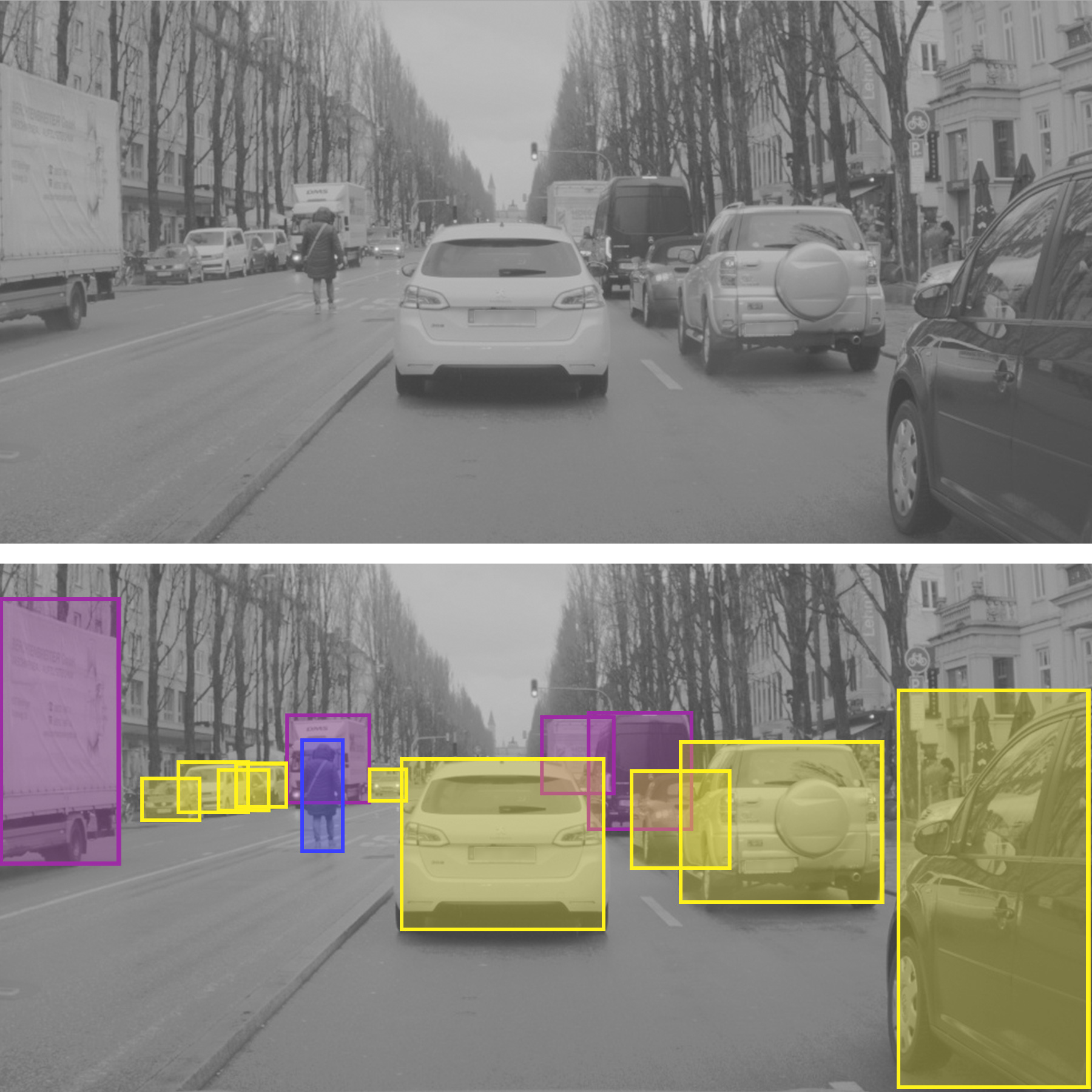
We are not interested in identifying any specific persons and our systems are not configured for this purpose. Traffic objects are classified exclusively by category: "Person" for pedestrian, "passenger car", "lorry", "motorbike" and so on. No individual identification takes place. In terms of data protection, no image processing for the identification of persons takes place. The aim is not the identification of individual persons, but unambiguous object detection.

The image shows the video recording and the data extracted by software.

Image 1: Collection of the images
Image 2: Evaluation of the images

The processing of the data on the camera recordings is based on legitimate interests pursuant to Art. 6 (1) lit. f GDPR.  BMW has a legitimate interest in further developing safety-relevant assisted, connected, partly automated and autonomous driving functions and thus helping to improve general safety in road traffic. Personal identifiability is reduced as early as possible in the process.

  • In the vehicle: The data is only recorded with the user's consent. The data is also only recorded when a specific trigger event occurs that is relevant for the further development of the driving functions. The relevant data is then stored in the vehicle in encrypted form to enable secure transmission to BMW.
  • Protection of the personal identifiability of other road users: As the recordings are made on public roads, other road users may be visible on the video recordings. BMW takes technical measures to reduce any personal identifiability of this data as far as technically possible. For this purpose, BMW has implemented a technology in the above vehicle models that uses visual masking to automatically obscure the faces of road users and licence plates that may have been captured directly in the vehicle as far as possible before they are transmitted to BMW's IT back end. After successful transmission to BMW, all temporarily stored data is automatically deleted from the vehicle.
  • Transmission and processing in BMW's IT back end: The data is saved and processed according to the state of the art. The following security measures are examples of how we protect your personal data from misuse or other unauthorised processing:
    • Collected data is transmitted and stored in encrypted form only.
    • The data collected in the vehicle is transmitted to BMW exclusively in encrypted form. After being received in the BMW systems, the data is further de-personalised through deletion of the vehicle identification number (VIN) of the vehicle that collected the data from the back end shortly after successful transmission, meaning that the information collected can no longer be traced back to a specific vehicle. This ensures that the remaining video data no longer contains a personal identifier for the vehicle.
    • Access to personal data is restricted to a limited number of authorised persons for the stated purposes:
    • The IT systems used for processing the data are technically segregated from other systems to prevent unauthorised access, e.g. through hacking.
    •  In addition, access to these IT systems is constantly monitored in order to detect and prevent misuse at an early stage.

Video data and the associated sensor data (including location information) are only stored for as long as they are required for the further development of the vehicle functions. The data is regularly checked and deleted as soon as it is no longer required for this purpose.

Data that is required by law or to fulfil regulatory requirements relating to vehicle approval may be retained until the end of the respective vehicle life cycle.

Protection of the privacy of other road users is guaranteed throughout by reducing personal identifiability as far as technically possible and at the earliest possible stage. The data therefore usually no longer allows any conclusions to be drawn about identifiable persons in road traffic.

We may share collected data, including video recordings, with carefully selected third parties, including development and technology partners. These partners use the data exclusively for their own development and research purposes in the field of assisted, connected, partly automated and autonomous driving functions.

Our cooperation partners include selected component manufacturers for the joint use of previously collected video data in order to cooperate in the field of research and development. These partners are bound by contractual as well as technical and organisational measures for the careful handling of data. We also commission carefully selected suppliers (including development and technology service providers) as part of data processing agreements. The transfer is subject to a strict purpose limitation – the data may be used for the development of driver assistance systems as well as related vehicle technologies. 

If data is processed in countries outside the European Union (EU), BMW uses EU standard contracts, with appropriate technical and organisational measures, to ensure that personal data is processed in accordance with European data protection standards. If you wish to view the specific safeguards for the transfer of data to other countries, please contact us through one of the communication channels listed below.

The European Union has already established a comparable level of data protection for certain countries outside the EU, such as Canada and Switzerland. Since the level of data protection is comparable, data transfer to these countries does not require special approval or agreement.

Contact details, your rights as a data subject
and your right to complain to a supervisory authority.

If you have any questions relating to the use of your personal data, we recommend that you contact the BMW customer support of the respective BMW companies as your primary point of contact by sending a message to the following email address. Please find the corresponding address here.

You can also contact the responsible data protection officer:

BMW AG
Data Protection Officer
Petuelring 130
80788 Munich

Email:  datenschutz@bmw.de

Rights of the data subject.

As the person affected by the processing of your data, you may claim certain rights under the GDPR and other relevant data protection regulations.

Preliminary remarks: In certain situations, we may only be able to fulfil your rights as a data subject such as the right of access and rights to rectification, data portability or objection to a limited extent. The background to this is that the persons visible in the event-related video sequences cannot be technically identified without additional information about the location, time and type of situation. In particular, the personal identifiability of the road users recorded is already minimised in the vehicle as far as technically possible. Furthermore, the data is not assigned to a specific person either in the vehicle or in the BMW IT back end. However, if you provide us with sufficiently specific additional information regarding your identification, we will check on a case-by-case basis whether an assignment is possible and whether we can fulfil your request. Even with this additional information, we may not be able to verify your right of access and rights to rectification, data portability or objection to the data unless we are able to identify you with certainty. These rights as a data subject may also be restricted by the rights of others.

Under the GDPR, you are entitled to the following rights as a data subject vis-à-vis BMW:

Right of access (Art. 15 GDPR):

You have the right to request information on the data we hold about you from us at any time. This information includes, but is not limited to, the categories of data we process, the purposes for which it is processed, the source of the data if not collected directly from you and, if applicable, the recipients with whom we have shared your data. You can obtain a copy of your data from us free of charge. If you require multiple copies, we reserve the right to charge you for these copies. Please also note the additional information above. Please also note the additional information above in the preliminary remarks regarding the rights of data subjects.

Right to rectification (Art. 16 GDPR):

You have the right to request that we correct your data. We will take reasonable steps to keep the information we hold and process about you accurate, complete and up to date based on the most current information available to us. Please also note the additional information above in the preliminary remarks regarding the rights of data subjects.

Right to erasure (Art. 17 GDPR):

You have the right to request that we erase your data, as long as the legal requirements for this are satisfied. This may be the case under Art. 17 GDPR if:

  •  the data is no longer required for the purposes for which it was collected or otherwise processed;
  • you withdraw your consent on which data processing is based, and there is no other legal basis for processing;
  • you lodge an objection to the processing of your data and there are no overriding legitimate reasons for processing, or you object to data processing for direct marketing purposes;
  • the data was processed unlawfully

and provided that processing is not required

  • to ensure compliance with a legal obligation that requires us to process your data;
  • particularly with regard to statutory retention periods;
  • to establish, exercise or defend legal claims.

Right to restriction of processing (Art. 18 GDPR):

You have the right to request that we restrict the processing of your data if:

  • you dispute the accuracy of the data – in which case processing may be restricted during the time it takes for us to verify the accuracy of the data;
  • the processing is unlawful, and you reject the erasure of your data, requesting that its usage be restricted instead;
  • we no longer need your data, but you need it to establish, exercise or defend legal claims;
  • you have lodged an objection to its processing, as long as it is not certain that our legitimate grounds outweigh yours.

Right to data portability (Art. 20 GDPR):

You have the right to request that we transfer your data – if technically possible – to another responsible party. However, you may only enforce this right if data processing is based on your consent or is necessary for the performance of a contract. Rather than receiving a copy of your data, you may also ask us to submit the data directly to another responsible party specified by you. Please also note the additional information above in the preliminary remarks regarding the rights of data subjects.

Right to object (Art. 21 GDPR):

You have the right to object to the processing of your data at any time for reasons that arise from your particular situation, as long as data processing is based on your consent, on our legitimate interests or those of a third party. In this case, we will cease to process your data. This does not apply if we can show that there are compelling legitimate grounds for processing that outweigh your interests, or if we need your data for the establishment, exercise or defence of legal claims. Please also note the additional information above in the preliminary remarks regarding the rights of data subjects.

Time limits for compliance with the rights of the data subject

We make every effort to comply with all requests within one month. However, this period may be extended for reasons relating to the specific right or complexity of your request. In this case, we will inform you of the deadline extension and the reasons for it within one month of receiving your request.

Right to lodge a complaint        

BMW AG takes your concerns and rights very seriously. However, if you believe that we have not adequately addressed your complaints or concerns, you have the right to lodge a complaint with your local data protection authority or seek a judicial remedy.

Frequently asked questions.

The data collection takes place exclusively in selected BMW brand vehicle types with the BMW Operating System X, which will be introduced in models starting from November 2025.

Only vehicles that are equipped with the necessary sensors and data processing architecture for the situational recording of environmental video data and where the respective customer has given their consent to data recording can participate in the data collection.

The following BMW models are affected: iX3, i3, 7 Series and X5, provided they have the operating system version specified above. Other models are not part of this data collection.

Modern driver assistance systems are safe, reliable and, of course, fulfil all legal requirements. However, we want to further optimise our systems.

The data from customer vehicles is intended for the further development and continuous refinement of safety-relevant driver assistance systems and automated driving functions. They also help us to make these systems even more precise and natural for you as a driver.

In principle, all driver assistance systems based on object detection can be further optimised by using sensor and video data. This includes, among other things:

  • Emergency Brake Assistant
  • Lane Change Assistant
  • Automatic Park Assistant
  • Active Cruise Control (ACC)
  • Speed Limit Info

No. The data from the corresponding vehicles is not collected continuously, but on an event basis.  This means: Data is not collected continuously, but only when it serves a predefined use case – for example, when the Emergency Brake Assistant is triggered or an unexpected obstacle is detected ("trigger event").

If such a trigger event occurs, data from various sources in the vehicle is recorded for a maximum of 120 seconds.

The vehicle's exterior cameras can be used to record the following:

  • Image and video data of other road users (vehicles, pedestrians, cyclists, other objects)
  • Licence plates and lettering on vehicles
  • Road signs and buildings in the surrounding area
  • Other information in the vehicle's immediate vicinity

 In addition to the video data, further data can be collected from the vehicle:

  • Sensor data (radar, ultrasound)
  • GPS position of the vehicle and timestamp of the recording
  • Vehicle system information (e.g. speed, steering angle, brake pedal position)
  • Data on weather and lighting conditions

In order to train and improve the recognition of road users, traffic situations and other objects for driver assistance systems in a sustainable manner – so that they can learn from many real situations and be designed for complex traffic situations – it is necessary to record situation-relevant video data during trigger events.

In many cases, the recording of bystanders is unavoidable. However, these are not the subject of the individual event evaluation and are not identified at any time.

Processing the traffic infrastructure and detecting the vehicle's surroundings, obstacles and road users, including their direction of movement, is essential in order to enable a clear assessment of the specific traffic situation and to derive appropriate vehicle responses.

No. Faces and vehicle licence plates recorded by the cameras are automatically obscured directly in the vehicle before data is transmitted to the manufacturer's IT back end.

No. No personal identification takes place. The vehicle systems merely recognise object classes such as "person", "bicycle" and "passenger car".

BMW uses targeted de-personalisation measures for video data to ensure that the data collected cannot be related to a specific person or vehicle:

  1. Automatic anonymisation directly in the vehicle:
    Before data is transmitted to BMW, the faces and licence plates of other road users are automatically obscured in the vehicle. This reduces possible personal identifiability as early as possible.
  2. Further de-personalisation in the manufacturer's IT back end:
    After the data has been transmitted from the vehicle to the manufacturer's IT back end, further measures are taken so that no conclusions can be drawn about a specific vehicle or vehicle owner/user. All identifying vehicle features of the recording vehicle are removed before the data is used for development and analysis purposes.

No. No motion profile is explicitly created of the vehicle user or road user, and this is actively prevented by the use of suitable measures.

The GPS position of the vehicle is only recorded during the trigger event in order to be able to trace the locations at which a vehicle function did not respond as intended, to be able to reconstruct this situation in the development process and to gain knowledge about regional patterns (e.g. of certain trigger events).

The data collected in the vehicle is only stored temporarily and is automatically deleted in the vehicle after successful transmission to the BMW IT back end. In the back end, the video data and associated sensor data, including location information, are only stored for as long as they are required for the further development of the driving functions. The data is regularly checked and deleted as soon as it is no longer required for this purpose.

Data that is required by law or to fulfil homologation requirements can be retained until the end of the respective vehicle life cycle.

In principle, yes, but assignment to a specific person is not technically possible as no personal identification takes place. No individual scene can be found without precise information (place, time, situation). In addition, trigger events are rare, so it is highly unlikely for an environmental recording to be saved during standard driving.

Access to video data (as well as all other data collected) is strictly regulated. Access is only granted to authorised persons and only for clearly defined purposes. All data storage systems are technically segregated and monitored for unauthorised access.

Yes, data can be passed on to carefully selected development and technology partners and other manufacturers in individual cases.

All data is passed on without vehicle identification and is subject to strict purpose limitation.

You have the following rights under the General Data Protection Regulation (GDPR):

  • Right of access (Art. 15): Information about stored data
  • Right to rectification (Art. 16): Correction of incorrect data
  • Right to erasure (Art. 17): Deletion of your data under certain conditions
  • Right to restriction (Art. 18): Restriction of processing
  • Right to data portability (Art. 20): Transfer of your data
  • Right to object (Art. 21): Objection to processing

Please note: In certain situations, we may not be able to provide information on all data. For example, it is not possible for us to retrieve images of persons without additional information (date, time, location, whether pedestrian or in a vehicle), as individuals are not identified in the images.

If you have any questions relating to the use of your personal data, we recommend that you contact the BMW customer support of the respective BMW company as your primary point of contact. Please find the corresponding address here.

You can also contact the responsible data protection officer:

Data Protection Officer of BMW AG
Bayerische Motoren Werke Aktiengesellschaft

Petuelring 130
80788 Munich
Germany

Email: datenschutz@bmw.de

In case of complaints: BMW AG takes your concerns and rights very seriously. However, if you believe that we have not adequately addressed your complaints or concerns, you have the right to lodge a complaint with your local data protection authority or seek a judicial remedy.

Country Company Adress E-Mail Contact 
Austria BMW Group Central and Southeastern Europe Siegfried-Marcus-Str. 24, 5021 Salzburg, Austria info@bmwconnecteddrive.at
Belgium BMW Belux BMW Belgium Luxembourg NV/SA, Lodderstraat16, 2880Bornem info@bmw-connecteddrive.be
Bulgaria BMW Group Bulgaria 55, Nikola Vaptzarov Blvd., Expo 2000, 1407 Sofia, Bulgaria info.bg@bmwgroup.com
Croatia Tomic & Co. D. o. o. Folnegovićeva 12, 10000 Zagreb, Croatia gdpr@tomic.hr
Cyprus Char. Pilakoutas Ltd. 14, Meteoron Street, Strovolos Industrial Area, 2032 Nicosia, Cyprus dpoffice@pilakoutasgroup.com.cy
Czech Republic BMW Vertriebs GmbH Office Park, Nové Butovice, Bucharova 1423/6, 158 00 Praha 5, Czech Republic zakaznicky.servis.cz@bmw.com
Denmark BMW Danmark A/S Borgmester Christiansens Gade 50, 2450 Copenhagen SV, Denmark nordic.dataprivacy@bmw.dk
Deutschland BMW AG Petuelring 130, 80788 München kundenbetreuung@bmw.de
Estonia BMW Group Northern Europe Vetenskapsvägen 10, Box 794, 19127 Sollentuna, Sweden connecteddrive@bmw.ee
Finland BMW Group Suomi Äyritie 8 b, 01510 Vantaa, Finland nordic.dataprivacy@bmw.fi
France BMW France 5 rue des Hérons, 78180 Montigny-le-Bretonneux, France service-client@bmw.fr
Greece BMW Hellas Kimis Ave. & 10 Seneka str., Kifissia 14564, Greece bmwcustomercare@bmw.gr
Hungary BMW Magyarország Kft. Airport Business Park, Lõrinci út 59, 2220 Vecsés, Hungary ugyfelszolgalat@bmw.hu
Ireland BMW Group Ireland Swift Square, Santry Demesne, Dublin 9, Ireland customerservices@bmw.ie
Italy BMW Italia SpA Via dell'Unione Europea, 1, 20097 San Donato Milanese (MI), Italy data.protection@bmw.it
Latvia BMW Group Northern Europe Vetenskapsvägen 10, Box 794, 19127 Sollentuna, Sweden customerservice@bmw.lv
Lithuania BMW Group Northern Europe Vetenskapsvägen 10, Box 794, 19127 Sollentuna, Sweden connecteddrive.lt@bmw.com
Luxembourg BMW Belux BMW Belgium Luxembourg NV/SA, Lodderstraat16, 2880Bornem info@bmw-connecteddrive.lu
Malta Muscats Motors Limited Rue D'Argens, Gzira, GZR 1368, Malta info@mml.mizzi.com.mt
Netherlands BMW Group Nederland Einsteinlaan 5, Postbus 5808, 2280 HV Rijswijk, Netherlands privacy@bmw.nl
Norway BMW Group Norge Martin Lingesvei 17, PB 1, 1330 Fornebu, Norway nordic.dataprivacy@bmw.no
Poland BMW Group Ulica Woloska 22 A, 02-675 Warszawa, Polska info@bmw-connecteddrive.pl
Portugal BMW Group Portugal Lagoas Park, Ed 11 – 2º Piso, 2740-244 Porto Salvo, Portugal info@bmw.pt
Romania BMW Group Baneasa Business and Technology Park, 3rd floor, Building B, Soseaua Bucuresti-Ploiesti nr. 42-44, 013696 Bucharest, Romania infobmw@bmw.ro
Slovakia BMW Group Slovakia Karadžičova 8, 821 08 Bratislava, Slovakia zakaznicky.servis.sk@bmw.com
Slovenia BMW Group Slovenia Ameriška ulica 8, 1000 Ljubljana, Slovenia info.si@bmw.com
Spain BMW Avda. de Burgos, 118, Madrid 28050, Spain bmwconnecteddrive@bmw.es
Sweden BMW Group Northern Europe Vetenskapsvägen 10, Box 794, 19127 Sollentuna, Sweden nordic.dataprivacy@bmw.se
Switzerland BMW (Schweiz) AG Industriestrasse 20, 8157 Dielsdorf, Switzerland info.internet@bmw.ch
United Kingdom BMW United Kingdom Summit ONE, Summit Avenue, Farnborough, Hampshire, GU14 0FB, United Kingdom customer.information@bmw.co.uk